
If you want to compare online master’s degree programs quickly, start by using only sources that publish verifiable data and disclosures.
A fast decision comes from a small set of criteria you can check in under an hour, not from reading dozens of opinions.
Build a fast comparison grid in 30 minutes
Speed comes from committing to a short list of criteria that predict quality and fit better than marketing language.
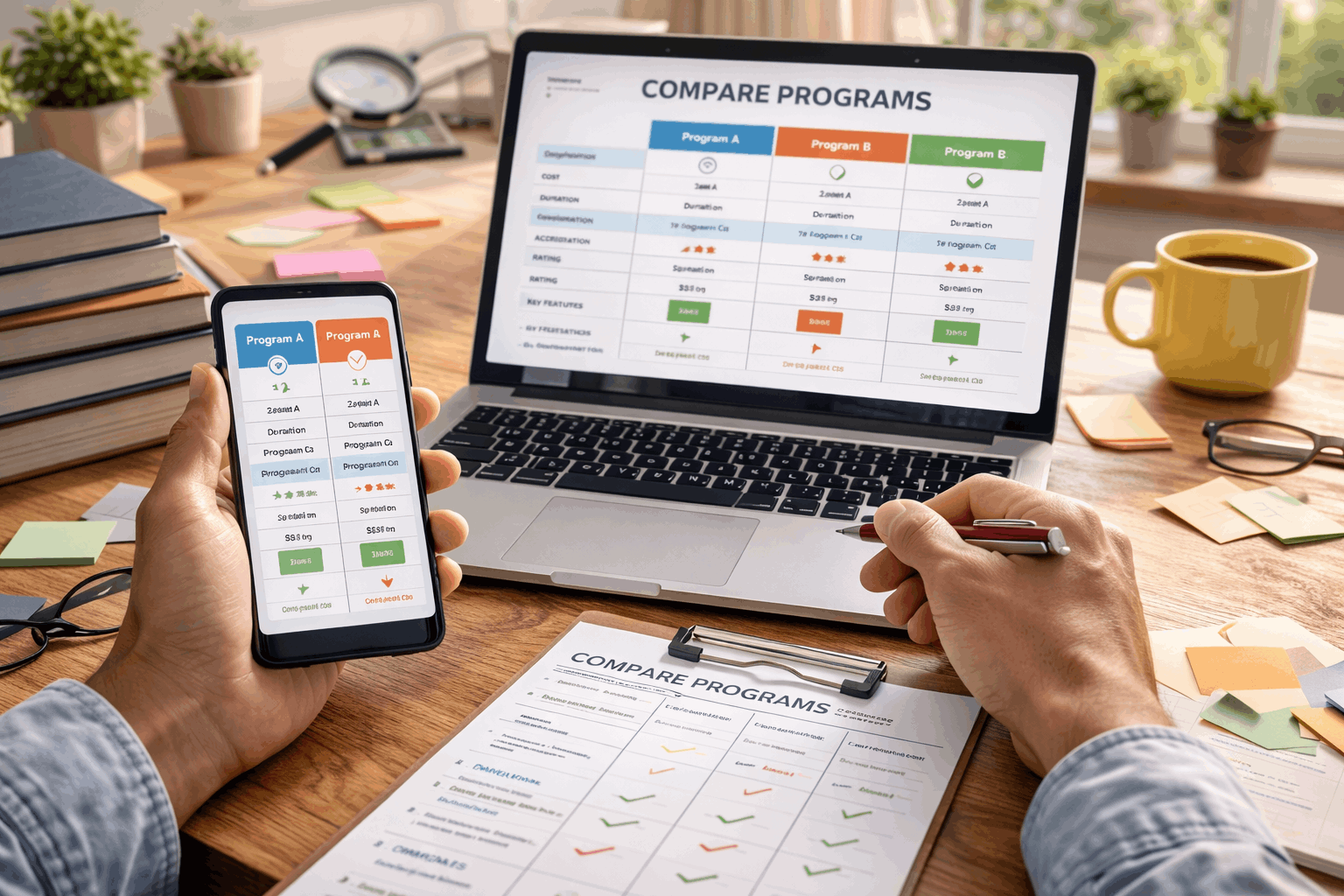
Create a one-page grid with columns for accreditation, total cost, pace options, required intensives, student support, and outcomes evidence.
Limit yourself to two to five programs at a time so the grid stays readable and decisions stay clear.
Use official databases and institutional disclosures first, then use rankings and reviews only as secondary context.
Pick criteria that eliminate weak options early
Start with non-negotiables like recognized accreditation, clear cost breakdowns, and a delivery format that matches your work and life schedule.
Add role-specific requirements such as licensure preparation, internship placement support, or a capstone structure that fits your goals.
Keep your list tight so you can compare programs online quickly and avoid spending time on details that will not change your decision.
Collect evidence in a single pass
Open each program’s official page and copy only the facts that map to your grid, like credit requirements, pacing, and whether there are mandatory live sessions.
Use government and accreditor databases to confirm claims instead of trusting badges, logos, or screenshots on a website.
When details are missing, mark the cell as “not disclosed” because missing information is a real comparison signal when you compare programs online.
Verify accreditation the right way
Accreditation matters because it is a quality review system and it often affects credit transfer, employer acceptance, and access to federal aid.
Do not rely on a school’s wording alone, because reputable verification is done through recognized directories and databases.
For U.S. institutions, the Department of Education’s DAPIP database is a primary place to confirm accredited status as reported by recognized accreditors.
CHEA also provides public searches for accredited institutions and programs, which helps you cross-check what you find elsewhere.
Confirm institutional accreditation in official databases
Search the institution in DAPIP to confirm the accreditor name and the current status, then record the accreditor in your grid.
Cross-check the same institution in CHEA’s institution search to reduce the risk of confusion with similarly named schools.
If you cannot verify the institution in these sources, treat that as a stop sign while you compare online college programs.
Check whether your field needs programmatic accreditation
Some professions and disciplines value programmatic accreditation, so verify program status when your career path expects it.
Use CHEA’s program search and programmatic accreditor listings to confirm whether a specific program is reviewed by a recognized specialized accreditor.
If a program claims specialized accreditation, match the claim to the accreditor’s scope and the exact degree level to avoid false equivalencies.
Compare cost using “net price” thinking, not sticker tuition
Tuition per credit is only one part of the cost, because fees, technology charges, books, and required residencies can change the total quickly.
For many students, the meaningful comparison is what people actually pay after typical grant aid, which is why net price tools exist.
IPEDS explains that net price is essentially the cost of attendance minus grants and scholarships, which is the logic you want in your grid.
If you see an institution offering federal aid, you should also expect it to provide a net price calculator, since NCES notes this is required for many Title IV schools.
Use net price calculators and standard cost disclosures
Look for the school’s net price calculator and record the estimated total for someone like you, then keep screenshots or notes for consistency.
Use NCES College Navigator to compare published tuition, fees, and other institutional data in a standardized format when it is available for your school list.
If you are comparing graduate programs where net price tools may be less precise, focus on total program tuition, required fees, and any travel costs.
Compare debt and affordability signals with national datasets
Use the College Scorecard to check program and institution data, such as typical debt metrics and earnings outcomes where available, then add them to your grid.
Treat big gaps between marketing claims and publicly reported data as a reason to slow down and ask direct questions before enrolling.
When you compare online master’s degree programs, aim to compare total program cost to realistic post-completion outcomes, not just monthly payment estimates.
Measure flexibility beyond “online” labels
Flexibility is about how the program runs in practice, not whether it uses a learning platform.
Your grid should capture whether courses are asynchronous, whether there are required live sessions, and how often deadlines reset.
Also record pacing options like part-time pathways, accelerated terms, and policies for leaves or pauses, because those determine real feasibility.
Finally, check support availability, since strong advising and accessible faculty can matter as much as schedule freedom for completion.
Evaluate pacing, workload predictability, and support
Write down term length, expected weekly workload ranges if disclosed, and whether you can take fewer credits without losing program momentum.
Look for concrete support signals, such as structured advising, access to tutoring, library services, and clear response-time expectations for instructors.
If a program cannot explain how students are supported in the online format, score that weakness honestly when comparing programs.

Validate outcomes with completion and career signals
Outcomes should be treated as evidence, so rely on datasets and disclosures that define metrics and update them regularly.
IPEDS graduation rate reporting exists to support disclosure and transparency, and it can help you understand institutional completion patterns.
The College Scorecard provides data tools, including outcome-oriented measures such as earnings and debt, that can support program comparisons.
If you need licensure, internship hours, or clinical placement, require clear documents of how the program meets those requirements.
Use completion and persistence indicators carefully
IPEDS explains how graduation rates data are collected and used for reporting, so treat these metrics as context rather than a single pass-fail number.
Compare similar institutions and student populations when possible, because rates vary by admissions selectivity, student mix, and program type.
If completion information is missing or vague on the program side, add a “not transparent” note because transparency is part of quality.
Check earnings and program value with College Scorecard
Use College Scorecard’s program and field-of-study views to compare earnings and related outcomes where the dataset provides them.
Pair those outcome signals with cost and debt data so you can judge value, not just prestige, when you compare two programs online.
If you cannot find outcomes in public datasets, ask the program for audited placement summaries or, where relevant, licensure pass rates.
Conclusion
Rank each program in your grid using a small scoring scale, then double-check any category that could block your goals, like accreditation or licensure fit.
Choose the option that clears non-negotiables first, then wins on total cost and schedule realism, and then has the strongest evidence of outcomes.
This approach keeps you from over-researching and helps you compare online college programs consistently each time you shop for education.